 how-to
7 Steps to Color Matching Paint for Vehicles
Last Updated: October 31, 2026
Quick Summary
Color matching paint for vehicles starts with finding your factory paint code, usually on the driver's side door jamb, under the hood, or inside the trunk. Run a car paint code lookup, then account for fading and production variants before ordering. Always do a test spray in daylight before painting the repair.
- The factory paint code is the only reliable starting point for any repair.
- The same code can appear under two different names depending on the paint system.
- Horizontal surfaces like hoods and roofs can weather faster than vertical panels.
- Compare variants in daylight and at multiple angles to catch metallic flake shifts.
- A scanner cannot recover a color that is no longer on the car.
Table of Contents
- Step 1: Find Your Factory Paint Code
- Step 2: Run a Car Paint Code Lookup
- Step 3: Account for Fading and Paint Variants
- Step 4: Do a Paint Color Match Test Spray
- Step 5: Choose OEM-Matched Automotive Paint
- Step 6: Know When Professional Car Paint Matching Pays Off
- Frequently Asked Questions
Step 1: Find Your Factory Paint Code
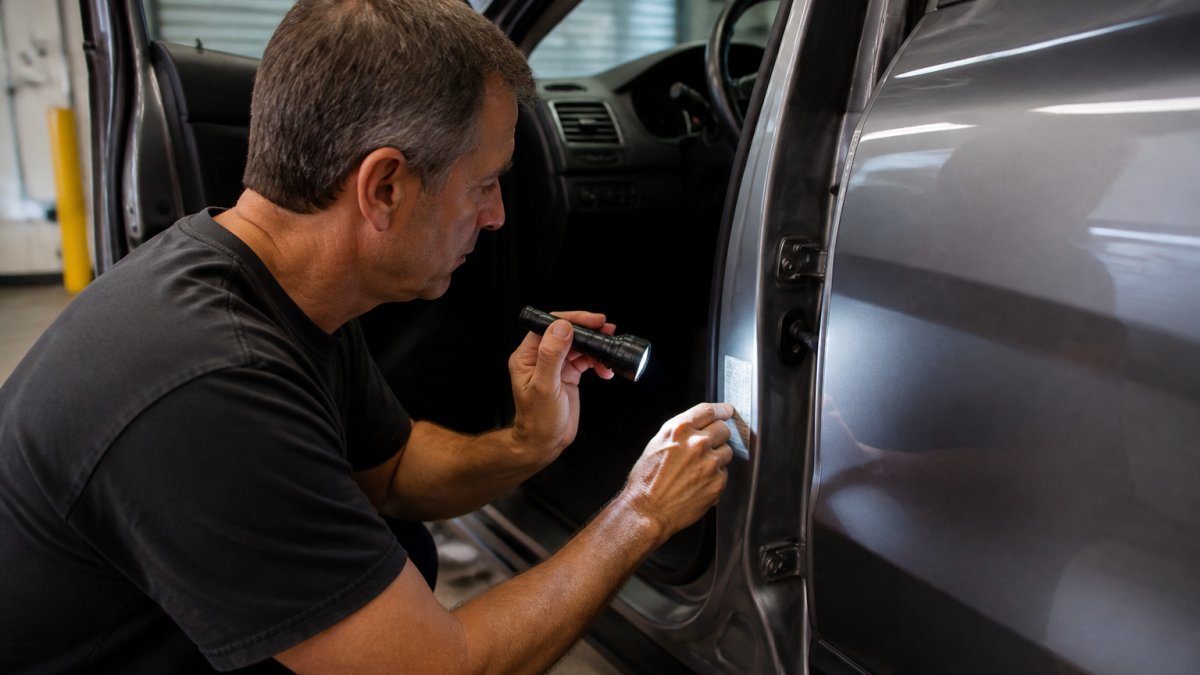
Color matching paint for vehicles starts with one number: your factory paint code, and that is where any color matching paint job begins. This code is the exact formula the manufacturer used when your car left the line, and it is the only reliable starting point for any repair. Skip this step and you are guessing.
Where the Paint Code Lives on Your Vehicle
Most drivers have never looked for it. The code is usually closer than you think:
- Driver's side door jamb, on a sticker or plate
- Under the hood, near the firewall or strut tower
- Inside the trunk lid or spare tire well
Look for a label with a short alphanumeric sequence, often labeled "paint," "color," or "C." Photograph it with your phone before you go anywhere.
Step 2: Run a Car Paint Code Lookup
A car paint code lookup turns that short code into a usable color name and formula. Many paint suppliers publish free lookup tools online, and dealership parts counters will confirm a code if you bring your vehicle identification number.
Here is the part most people get wrong. The same code can appear under two different names depending on the paint system. A code is a reference, not a guarantee.
Step 3: Account for Fading and Paint Variants
A factory code identifies the formula the manufacturer intended, not the color currently sitting on your panel. Two forces separate the two: weathering and production variants. Understanding both is what turns a code lookup into an actual match.
Why a Correct Code Can Still Look Wrong
Automotive paint is a layered system, primer, basecoat, and clearcoat, and each layer changes with age at a different rate. Clearcoat oxidizes and yellows under UV exposure, which shifts the apparent hue of everything beneath it.
Horizontal surfaces (hood, roof, trunk lid) can weather faster than vertical panels because they collect more sun and standing water. If you are repairing a door, compare against the door, not the hood.
What Paint Variants Actually Are
Manufacturers do not mix one batch of a color for an entire model run. The same code can be produced at different assembly plants, with different pigment suppliers, and across model years, producing small formula differences called variants. A variant is still the "correct" code, it is simply a closer match to a specific production window.
Variant selection matters most on:
- Metallic and pearl finishes, where flake size and orientation amplify small formula differences
- Reds, oranges, and some blues, which are the most sensitive to pigment variation
- Vehicles built across a model-year changeover, where the same code may span two variant families
How to Compare Variants Before You Buy
Some paint suppliers publish variant chips or spray-out cards for a given code, often labeled with a variant number or plant suffix. Ask your supplier whether they are available. Then:
- Clean the panel first. Road film and wax dull the surface and skew your read.
- Compare in the same light you will judge the repair in. Daylight is the reference; garage lighting hides shifts.
- Check at multiple angles. Metallic variants separate most clearly when you move your head side to side.
- Prefer the variant that matches the adjacent panel, not the panel being replaced, since the repair has to blend into what surrounds it.
When Weathering Beats Variant Selection
If the panel is heavily oxidized or the clearcoat is failing, a variant swap will not close the gap. In that case the realistic options are to polish and correct the existing finish first, to blend the new paint into the surrounding panels rather than trying for a panel-to-panel match, or to hand the job to a shop that can tint to the vehicle rather than to the code.
Step 4: Do a Paint Color Match Test Spray
A paint color match test spray is the cheapest insurance in this whole process. Spray a small card or scrap panel, let it cure fully, then hold it against the repair area in daylight.
Check it three ways:
- In direct sun
- In shade
- At an angle, to catch metallic flake and effect paint
Metallic and pearl finishes shift as you move around them. A match that looks right head-on can look wrong from the side. If the test card reads off, you need a variant, not more coats.
Step 5: Choose OEM-Matched Automotive Paint
OEM-matched automotive paint is mixed to the manufacturer's original formula for your code and variant. It comes in aerosol cans for small spot repair and in liquid form for spray gun work.
Match the format to the job:
| Job Size | Best Format | Why |
|---|---|---|
| Small chip or scratch | Touch-up pen or brush bottle | Fast, no masking |
| Larger spot repair | Aerosol spray can | Even coverage on small panels |
| Full panel or multiple panels | Liquid paint, spray gun | Control over thickness and blend |
Surface preparation matters as much as the color. A clean surface and proper primer keep the match looking right months later.
Step 6: Know When Professional Car Paint Matching Pays Off
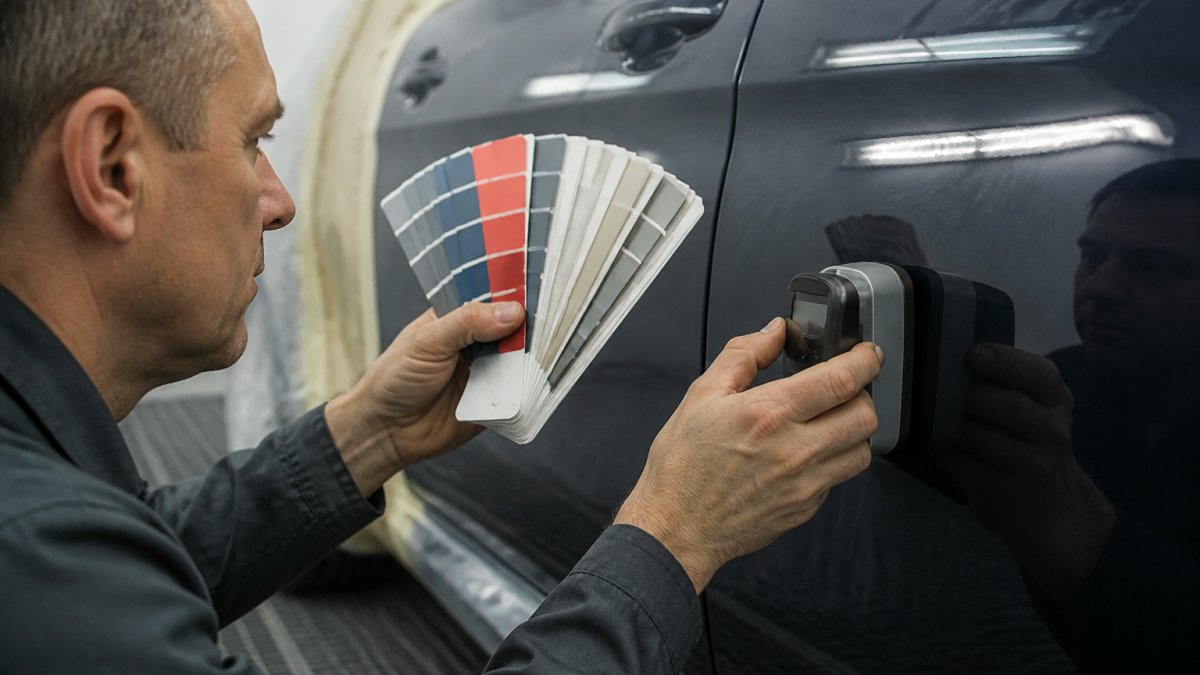
Professional matching is not just a bigger spray booth. It is a different method: a color scanner reads the actual finish on your vehicle, a mixing system tints to that reading, and a technician blends the result across adjacent panels. Knowing how that workflow operates tells you when it is worth the cost and when a touch-up bottle is genuinely enough.
How a Color Scanner Works, and How to Use It Accurately
A spectrophotometer or color scanner shines light on a surface and measures the reflected spectrum at multiple angles, then converts that reading into a formula a mixing bank can dispense.
Practical rules for an accurate scan:
- Scan a clean, cured, intact panel. Dirt, wax, and fresh paint all distort the reading.
- Avoid damaged or repainted areas. If the panel has body filler, primer showing through, or a prior respray, the scanner reads that finish, not the factory color. Move to an adjacent original panel.
- Take multiple readings. Most technicians scan two or three spots on the same panel and compare; a single reading is easy to skew.
Paint-System Compatibility: The Hidden Failure Mode
Primer, basecoat, and clearcoat are a system, not three independent products. Mismatches show up as:
- Lifting or wrinkling when a solvent in a topcoat attacks an incompatible or insufficiently cured layer beneath
- Poor adhesion when a primer is applied over a contaminated or wrong substrate
- Clearcoat peeling when a clear is not designed for the base under it
Staying within one paint system and following the manufacturer's recoat windows helps avoid this. A DIY buyer mixing brands across primer, base, and clear is taking on a compatibility risk that may not surface for months.
Safety and Ventilation
Automotive paints and clears contain isocyanates and solvents. Professional painting is typically done in a ventilated booth with supplied-air respiratory protection, skin coverage, and eye protection. Aerosol touch-up in an open garage is a different risk profile, but it still calls for ventilation, a respirator rated for organic vapors, gloves, and eye protection. Never spray in an attached garage without airflow, and never assume a dust mask is adequate.
Matching the Format to the Job
| Repair scope | Realistic format | What it buys you |
|---|---|---|
| Chip or single scratch | Touch-up pen or brush bottle | Color on the spot, no masking |
| Small spot, one panel | Aerosol, OEM-matched | Even coverage, manageable blend |
| Panel or multi-panel | Spray gun, mixed system | Control over film build and blend |
| Metallic, pearl, or faded finish | Scanner plus custom tint, blended | Match to the vehicle, not the code |
When to Hand It Off
Consider a professional shop when the repair spans a panel edge, the finish is metallic or pearlescent, the color has faded unevenly, the panel has prior bodywork, or the vehicle is a daily driver you cannot afford to redo.
If you would rather hand off the guesswork, you can repair the damage and restore the vehicle with a shop that handles body and paint work together. You can also see one shop for the whole vehicle if the repair involves mechanical work too, or tell us what your vehicle needs to get the process started.
Frequently Asked Questions
Can a paint code guarantee an exact color match?
No. A factory paint code identifies the original formula, but paint on your vehicle has aged under sun and weather, and manufacturers sometimes run multiple variants of the same code. A code gets you close; a test spray on a hidden panel confirms the match before you commit. Skipping that check is how mismatched panels happen.
How do I test automotive touch-up paint before applying it?
Spray or brush a small amount onto a test card or a hidden area such as inside the fuel door, let it cure fully, then compare it to the panel in daylight and shade. Metallic and effect paints shift tone with viewing angle, so check from several positions. If the test spray reads different from the panel, you likely need a variant, not more coats.
Why can new paint look different from the original finish?
Sun damage, fading, and weathering change the original finish over time, so a fresh batch mixed to the factory formula can look brighter or slightly off next to aged paint. Batch variation in pigment adds another variable. Blending into adjacent panels and choosing the closest variant are the standard fixes, which is why professional car paint matching often beats a straight code order on older vehicles.
Where can I find my vehicle's paint code?
Check the driver's side door jamb, the glovebox, the trunk lid, or the firewall under the hood. The code is usually on a service parts identification label or a dedicated sticker. If you cannot find it, a dealer parts counter or a body shop can pull it from the VIN, and that code is the starting point for any car paint code lookup.
Matching paint is a skill measured in patience and small details, and one wrong variant can undo a clean repair. Gridline Auto LLC brings diagnostics, body work, paint, and refinishing under one roof, so color matching is checked against the actual vehicle rather than a code alone. Our team focuses on precision in fit, finish, and color matching, with clear communication at every step. Get started with Gridline Auto LLC and get a finish that holds up.